The complete guide
Glass, metal or woven: choosing a candle warmer shade material
The shade is the part of a candle warmer you look at, and it is also the part that decides how the light behaves and how the heat moves. There are really three choices on the market.
Clear glass
The default, and the most efficient. Clear glass lets almost all the light out, so you see the melt pool easily and the lamp gives the most glow for the wattage. Fluted and ribbed versions break the light into bands for pattern without losing much brightness.
The trade-offs: it radiates heat outward as well as down, so the outside of the shade gets properly hot; it looks like empty glassware when switched off; and it is the most breakable option in a busy room.
Choose it if you want maximum performance and a clean look, or if you like being able to see the wax.
Coloured or mosaic glass
Amber, green and mosaic shades absorb a good deal of light and throw colour onto the walls. They look warm even when off, which matters for an object sitting out permanently.
The cost is brightness and a little melting speed — expect to run a coloured shade a step brighter than a clear one. Mosaic shades add cleaning difficulty and fragility on top.
Choose one if the lamp is going somewhere visible and you want it to be an ornament as much as an appliance.
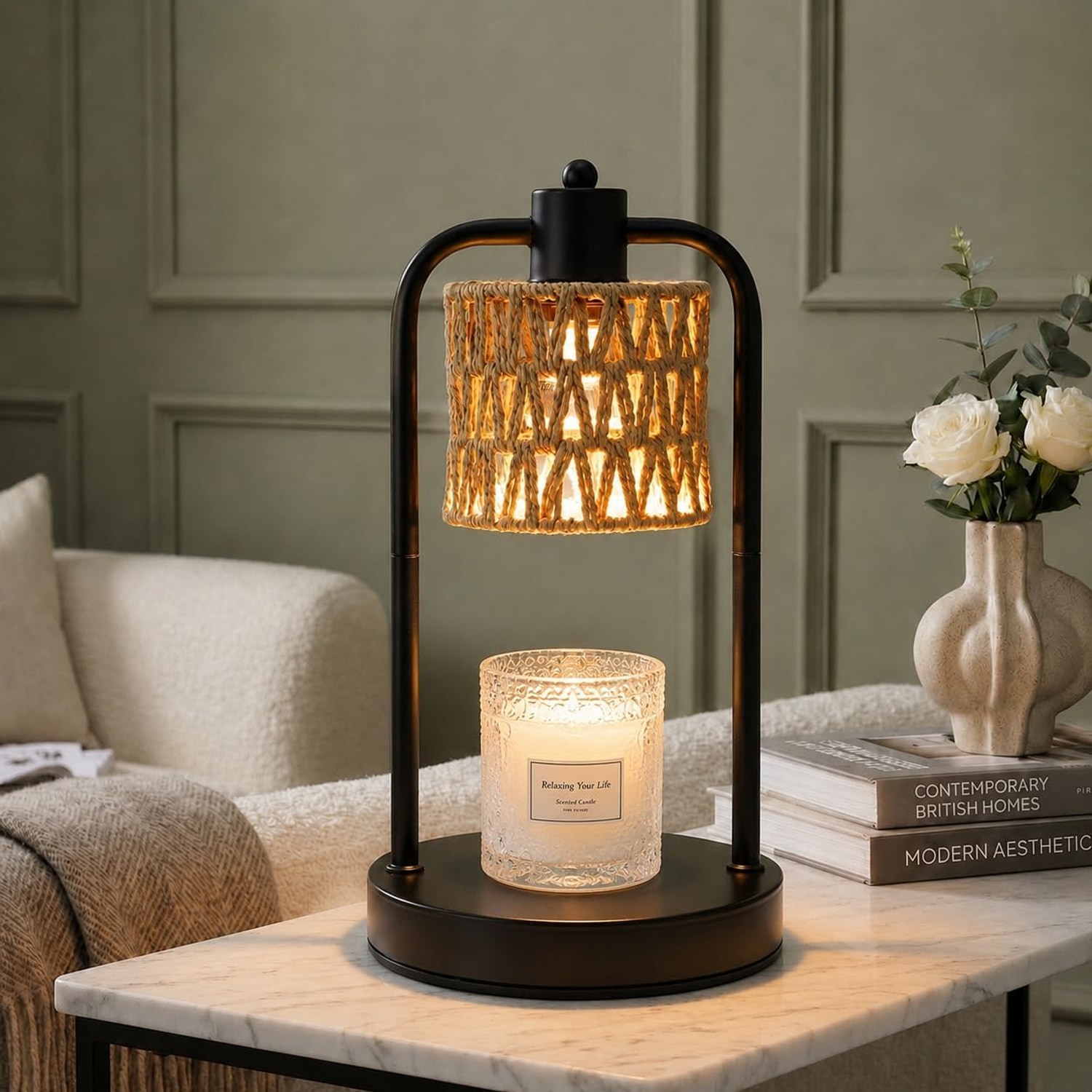
Woven fibre
Hemp, rattan and similar shades behave differently. They insulate rather than radiating, so more heat goes down onto the candle and the outside stays cooler to be near. The light comes through the weave as a scatter of small points, which is the softest effect of the three.
They also bring texture to a room in a way glass never does, and they are the only type that reliably folds or collapses for storage.
The trade-offs are cleaning — dust only, never damp — and marking. A woven shade shows handling, and you cannot wipe a fingerprint off it.
Choose one if your room has linen, wood and plants in it, or if you want to be able to put the lamp away out of season.
What does not change
The wattage of the bulb, the melting mechanism and the effect on the candle are essentially the same whichever shade you pick. A rope shade and a glass shade with the same bulb will both melt a candle evenly and both make it last far longer than burning it does.
So the choice is genuinely about the room and how you live with the object, rather than about performance.
The short version
Clear glass for brightness and seeing the pool. Coloured or mosaic for a lamp that decorates the room. Woven fibre for texture, cooler outside surfaces, and the ability to fold it away. The candle does not care.