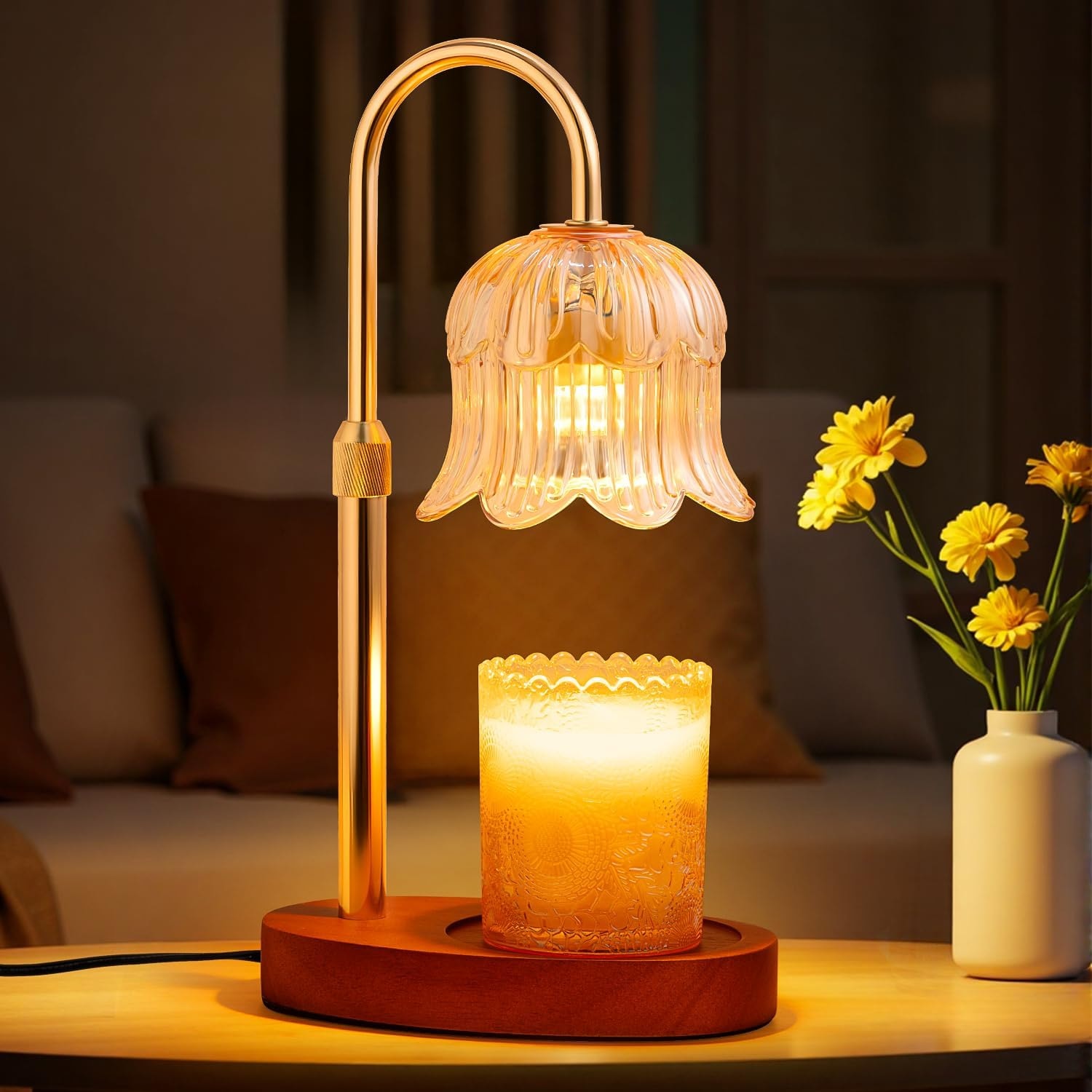
The complete guide
Candle warmer lamp safety: what actually needs your attention
Candle warmers are bought almost entirely because they are safer than an open flame, and that is a fair reason: no flame means no candle fire, no soot, no smoke and nothing to forget to blow out. But a warmer is not a zero-risk object. It is a mains-powered lamp with a hot bulb, and there are a handful of things worth knowing.
The bulb gets genuinely hot
The shade and the area immediately around the bulb reach a temperature that will give you a nasty surprise if you grab them mid-session. Always switch off and give it ten minutes before moving the lamp, changing the height or lifting the candle out.
That is also why the lamp needs air above it. Do not site one directly beneath a shelf, a wall cabinet or a low overhang — heat rises, and the space above the shade is how it escapes.
Wax and glass
Warmed jars get hot too. Slide the candle out with the lamp off and cool, and let a freshly melted candle set before you carry it anywhere, or you will spill a pool of liquid wax across a wooden surface.
Never put water on or near a hot candle jar. Thermal shock cracks glass, and a cracked jar full of liquid wax under a hot bulb is the one genuinely messy failure mode of these lamps.
Use candles in glass, metal or ceramic. Not plastic, and nothing with dried flowers or wooden ornaments sitting in the wax — a flame only melts the middle, but a warmer melts the whole surface, decorations included.
Electrical basics
Use the bulb the lamp is specified for and do not fit a higher wattage in the hope of a faster melt. The fitting, wiring and shade are designed around a specific heat output.
Keep the cable where nobody will hook a foot or a sleeve through it — a 1 kg lamp with a hot bulb coming off a table is worse than a knocked candle. Do not run it from a daisy chain of extension leads, and do not use it in a bathroom.
If the lamp ever smells of hot plastic rather than warm metal, or the controller gets hot, stop using it and contact us.
Children and pets
A warmer is a real improvement on an open flame in a house with either, and that is why most people buy one. It is not, though, a child-safe object: the shade is hot, it is glass, and it is on a cable that can be pulled.
Put it on a high, stable surface, well back from the edge, with the cable dressed behind furniture. Cats in particular treat a warm glowing lamp as an invitation.
Running it unattended
The timer exists precisely so the lamp can be left. Using it is sensible rather than optional: it means the lamp cannot run for a day and a half because everyone went out.
Leaving the house with it running is fine on a timer, on a stable surface, clear of fabric. Leaving it running for days on end is not — bulbs fail, and you want to be there when one does.
The short version
Hot bulb, hot shade, hot jar — switch off and wait before touching anything. Air above the shade. Correct wattage only. Cable out of harm's way. Glass, metal or ceramic candles with nothing decorative set into the wax. Timer on, especially when you are out or asleep.